How Therapists Can Rank Higher in Local Google Searches
Showing up in local Google search is the single highest-leverage thing a therapy practice can do for consistent patient growth. Here is exactly how to do it — step by step.
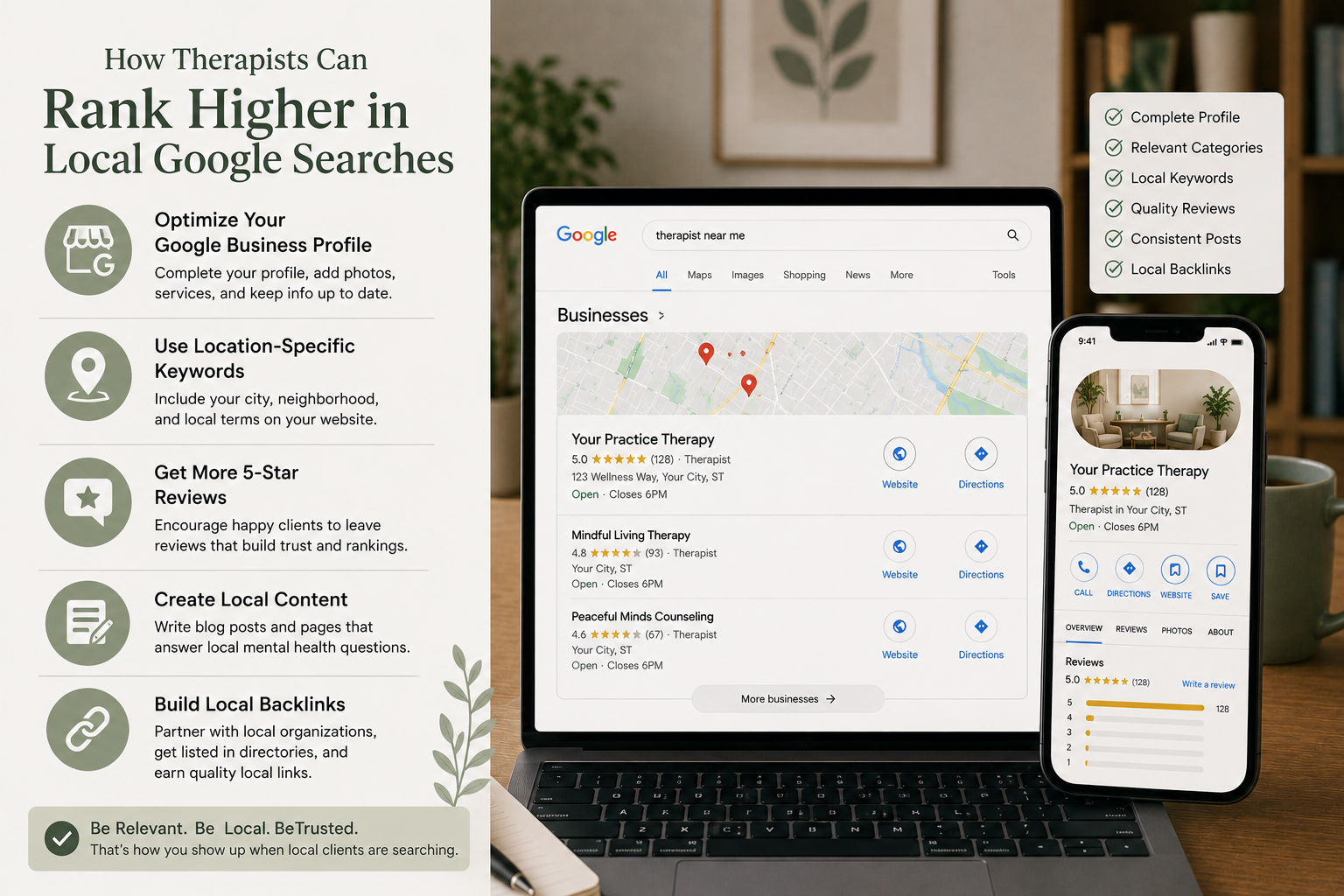
How Therapists Can Rank Higher in Local Google Searches:
When a patient in your city decides they are ready to find a therapist, they open Google. They type something like "therapist near me" or "anxiety therapist in [city]." A map appears with three local results. They click one of the first two. They book.
If your practice is not in those first three results — you do not exist to that patient.
Local Google search is where therapy practices are won and lost. Here is exactly how to rank higher — step by step, in plain language.
What Local Search Actually Is
When someone searches for a service in a specific location — "therapist in Brooklyn" or "couples counseling near me" — Google shows two types of results.
The first is the local pack. This is the map at the top of the results page with three business listings. These come directly from Google Business Profiles. Getting into the local pack is the single highest-leverage thing a therapy practice can do for local visibility.
The second is organic results. These are the regular website links below the map. Ranking here requires SEO work on your actual website — content, page optimization, and backlinks.
Both matter. But the local pack is where most therapy practices have the biggest untapped opportunity — because it is driven almost entirely by your Google Business Profile, which most practices have barely touched.
Step 1: Claim and Complete Your Google Business Profile
If you have not claimed your Google Business Profile yet, do it today at business.google.com. Google automatically creates basic listings for businesses — which means there is likely a profile for your practice sitting there right now with incomplete or inaccurate information being shown to potential patients.
Once claimed, fill out every single field. This is not optional. Google uses the completeness of your profile as a ranking signal. An incomplete profile tells Google you are not serious about being found.
What to fill out completely:
Your business name exactly as it appears everywhere else. Your address or service area. Your phone number. Your website URL. Your hours including whether you are accepting new patients. Your primary and secondary categories — use "Mental Health Clinic" or "Psychotherapist" as your primary. Your services — list every condition you treat and every type of therapy you offer. Your description — write two to three sentences that include your specialty, your city, and the type of patients you help.
Step 2: Write a Description That Contains Your Keywords
Your Google Business Profile description is one of the most underused ranking tools available to therapy practices.
Most profiles have something generic like "compassionate, client-centered therapy for individuals and couples." That description contains none of the keywords patients actually search.
A description built for local search sounds like this:
"We provide individual therapy, couples counseling, and anxiety treatment in [city], TX. Our therapists specialize in depression, trauma, and life transitions. Accepting new patients for in-person and telehealth sessions."
That description contains the exact phrases patients type into Google. It tells Google what you do, where you do it, and who you help. That is the information Google needs to rank you for the right searches.
Step 3: Build a Consistent Review Stream
Reviews are one of the three primary factors Google uses to rank local businesses — along with relevance and distance. And not just the number of reviews. The recency of them.
A practice with fifty reviews, the newest from nine months ago, is being outranked by a practice with twenty reviews, the newest from last week. Google interprets recent reviews as a signal that the business is active and trustworthy.
The most effective way to collect reviews consistently is automation. A post-session email sent twenty-four hours after an appointment with a direct link to your Google review page generates a steady stream of fresh reviews without you ever having to ask in person. Set it up once. Let it run.
One thing worth noting: never offer incentives for reviews, never ask patients to write reviews during a session, and never post fake reviews. Google detects all of these and penalizes profiles that engage in them.
Step 4: Keep Your Directory Information Consistent
Google cross-references your business information across the web. If your name, address, and phone number appear differently on Psychology Today than they do on Healthgrades than they do on your Google Business Profile — Google loses confidence in your listing and ranks it lower.
This is called NAP consistency — Name, Address, Phone number. It needs to be identical everywhere your practice appears online.
Go through every directory you are listed on — Psychology Today, Zocdoc, Healthgrades, Yelp, Apple Maps, Bing Places — and make sure your information matches exactly. Same abbreviations. Same phone number format. Same business name. No variations.
Step 5: Publish Content Targeting Local Keywords
Your Google Business Profile drives local pack rankings. Your website content drives organic rankings below the map.
The most effective content for local SEO targets specific searches that patients in your city are making. Not just "therapy" — but "anxiety therapist in [city]," "online therapy [city]," "couples counseling [neighborhood]."
A dedicated service page for each specialty you offer — each one mentioning your city and targeting a specific search — tells Google exactly what you do and where. A blog that publishes one article per month targeting a question your local patients are searching builds topical authority over time that compounds into higher rankings across every relevant search.
Step 6: Post Regularly to Your Google Business Profile
Google Business allows you to publish short posts — updates, tips, announcements, offers — directly to your profile. Profiles that post regularly signal to Google that the business is active and engaged.
Most therapy practices post never. Which means posting even once or twice a month puts you ahead of the majority of competitors in your area.
Posts do not need to be long or elaborate. A short tip related to your specialty. An update about your availability. A link to your latest blog post. Thirty minutes a month spent on Google Business posts is one of the highest-return activities available to a local therapy practice.
How Long Does This Take to Work
For the local pack — the map results — you can see meaningful movement in thirty to ninety days if you optimize your profile, build consistent reviews, and fix your directory information.
For organic rankings below the map — you are looking at three to six months of consistent content before you see significant traffic. But once those rankings are established they hold. Unlike paid ads that stop the moment you stop paying, organic rankings keep working long after the work is done.
The practices at the top of local search in their cities right now started this work six to twelve months ago. The best time to start was then. The second best time is today.
The Bottom Line
Ranking higher in local Google search is not complicated. It is consistent. A complete Google Business Profile, a steady stream of fresh reviews, consistent directory information, and content that targets local keywords — done consistently over time — builds the kind of local visibility that fills calendars without a dollar spent on ads.
If you want all of it handled for you — Google Business optimization, directory management, review automation, local SEO content — that is exactly what Practado does for mental health and telehealth practices every single month. Book a free strategy call or visit practado.com/book to see what's included.