Why Most Therapy Practices Waste Money on Marketing Agencies
Hiring a marketing agency feels like the right move when your calendar is slow. For most therapy practices it ends up being an expensive lesson. Here's why — and what actually works instead.

Why Most Therapy Practices Waste Money on Marketing Agencies:
Hiring a marketing agency feels like the logical next step when your practice is not growing the way you want it to.
You are busy with clinical work. You do not have time to learn Google Ads or figure out SEO. You need someone who knows what they are doing. So you find an agency, sign a contract, and start paying a monthly retainer.
Three months later your calendar looks the same. Six months later you have spent thousands of dollars and have almost nothing to show for it.
This is not a rare experience. It is the most common outcome when therapy practices hire generalist marketing agencies. Here is exactly why it happens — and what to do instead.
The Core Problem: Generalist Agencies Do Not Understand Healthcare
Most marketing agencies are built to serve e-commerce brands, local restaurants, law firms, and real estate agents. Mental health practices are a completely different animal — and most agencies do not realize how different until they are already spending your money figuring it out.
Here is what a generalist agency does not know when they take on a therapy practice:
They do not understand HIPAA. Running ads for a therapy practice requires a completely different approach to targeting, retargeting, and data collection than running ads for a clothing brand. You cannot retarget someone who visited a page about depression the same way you retarget someone who looked at a pair of sneakers. The compliance requirements are specific, consequential, and largely invisible to agencies that have never worked in healthcare.
They do not understand the patient decision-making process. The way someone decides to book a therapy appointment is fundamentally different from the way they decide to buy a product. The emotional stakes are higher. The trust required is deeper. The timeline is longer. An agency optimizing for clicks and conversions without understanding this psychology will consistently produce campaigns that perform well on paper and poorly in reality.
They do not know your directories. Psychology Today, Zocdoc, Healthgrades, TherapyDen — these platforms are central to how patients find therapists. A generalist agency has never heard of most of them, has no relationships with them, and has no idea how to optimize your presence on them.
They do not speak your patient's language. Writing copy for a therapy practice requires understanding how patients describe their own pain — the anxiety, the relationship strain, the burnout — and mirroring that language in a way that makes them feel seen. Generalist copywriters default to clinical jargon or generic wellness language that converts nobody.
The Contract Trap
Most marketing agencies require a minimum contract — typically six to twelve months. This protects them while they spend the first two to three months learning your industry, testing approaches that do not work, and optimizing campaigns that should have been built correctly from the start.
You pay for their learning curve. And if the results are not there at month four, you are still locked in for another eight months.
By the time the contract ends, many practices have spent ten to twenty thousand dollars and generated a handful of leads that did not convert — because the agency built campaigns without understanding how therapy patients actually make decisions.
The Vanity Metrics Problem
Generalist agencies report on what they can measure easily — impressions, clicks, click-through rates, cost per click. These numbers look good in a monthly report. They do not tell you what actually matters: how many new patients booked an appointment.
A campaign can have a fantastic click-through rate and generate zero booked patients. It happens constantly with therapy practices working with generalist agencies. The agency celebrates the metrics. The practice wonders why the calendar is not moving.
The only metric that matters for a therapy practice is cost per booked patient. Everything else is noise.
What Actually Works
The practices seeing real, consistent growth from their marketing investment have one thing in common: they are working with people who understand mental health practice marketing specifically — not marketing in general.
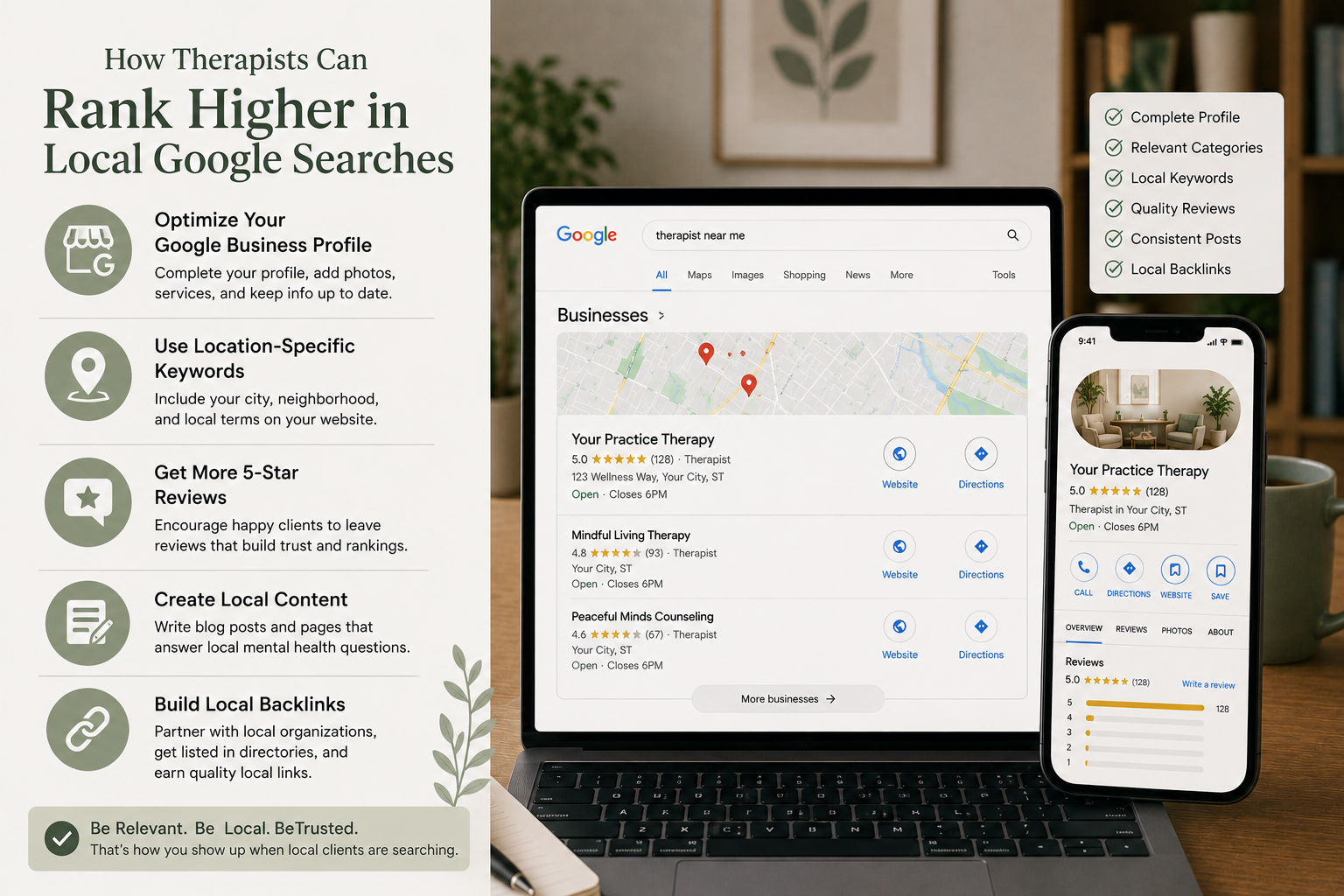
That means campaigns built with HIPAA compliance in mind from day one. Copy written in the language patients actually use when they describe their own struggles. Directories optimized correctly. Metrics reported against actual booked patient cost. And a system that connects all of it — ads, SEO, follow-up, reputation — into one coherent engine rather than a collection of disconnected tactics.
It also means no long-term contracts. A marketing partner confident in their results does not need to lock you in for twelve months. They earn your business every month by producing outcomes — not by making it expensive to leave.
The Bottom Line
Generalist marketing agencies are not bad at their jobs. They are bad at your job. Mental health practice marketing requires specific knowledge, specific compliance awareness, and specific understanding of how therapy patients find and choose a provider. Without that foundation, even a talented agency will spend your money getting up to speed — and your calendar will not move while they do.
Practado was built exclusively for mental health and telehealth practices. Every campaign, every piece of copy, every directory listing, and every follow-up sequence is built around how therapy patients actually behave online — with HIPAA-aware processes by default and results reported against real booked patient cost. No long-term contracts. Ten new patients in sixty days or your money back. Book a free strategy call or visit practado.com/book to see what's included.