How to Get More Therapy Clients Without Relying on Psychology Today
Psychology Today is where most therapists start. It is not where the most successful practices stop. Here is how to build a patient acquisition system that does not depend on a single directory.

How to Get More Therapy Clients Without Relying on Psychology Today:
Psychology Today is the first place most therapists go when they want more clients. You set up a profile, pay the monthly fee, add a photo and a bio, and wait for inquiries to come in.
Sometimes they do. Often they slow down. And at some point you realize that your entire patient pipeline is sitting on a platform you do not own, cannot control, and cannot scale.
Psychology Today is a legitimate tool. But it is not a growth strategy. Here is what is.
The Problem With Depending on One Directory
When Psychology Today is your primary acquisition channel, your practice is at the mercy of one platform's algorithm, one platform's pricing decisions, and one platform's traffic.
If they raise their rates — you pay more or lose your listing. If their traffic drops — your inquiries drop with it. If a patient searches for a therapist and your profile does not appear on the first page of results — you might as well not be listed at all.
Practices that depend on a single channel for patient acquisition are one algorithm change away from a slow month that turns into a slow quarter.
The practices growing consistently are not dependent on any single platform. They have multiple channels working simultaneously — each one bringing in patients independently so that no single change can stop the flow.
What a Multi-Channel Acquisition System Looks Like
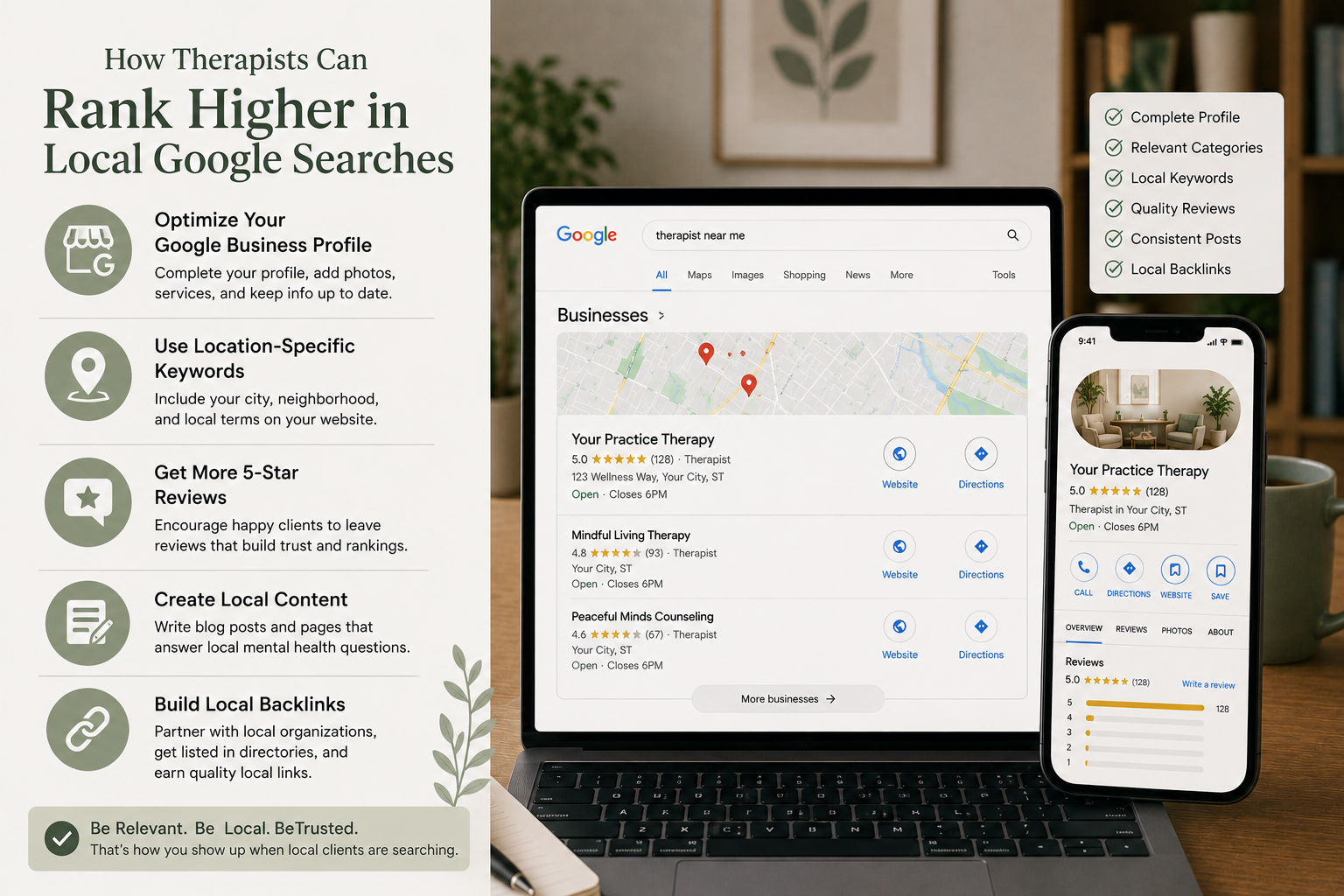
1. Google — Where the Highest Intent Patients Are
Psychology Today captures patients who are browsing directories. Google captures patients who are actively searching for help right now.
The difference in intent is significant. Someone on Psychology Today is comparison shopping. Someone who typed "anxiety therapist accepting new patients in [city]" into Google is ready to book.
Google Ads put your practice at the top of that search immediately. Local SEO — optimizing your Google Business Profile and building content over time — gets you there organically and keeps you there without a cost per click. The combination of both is the most powerful patient acquisition channel available to a private practice.
2. Your Own Website — The Asset You Actually Own
Your Psychology Today profile belongs to Psychology Today. Your Google Business Profile belongs to Google. Your website belongs to you.
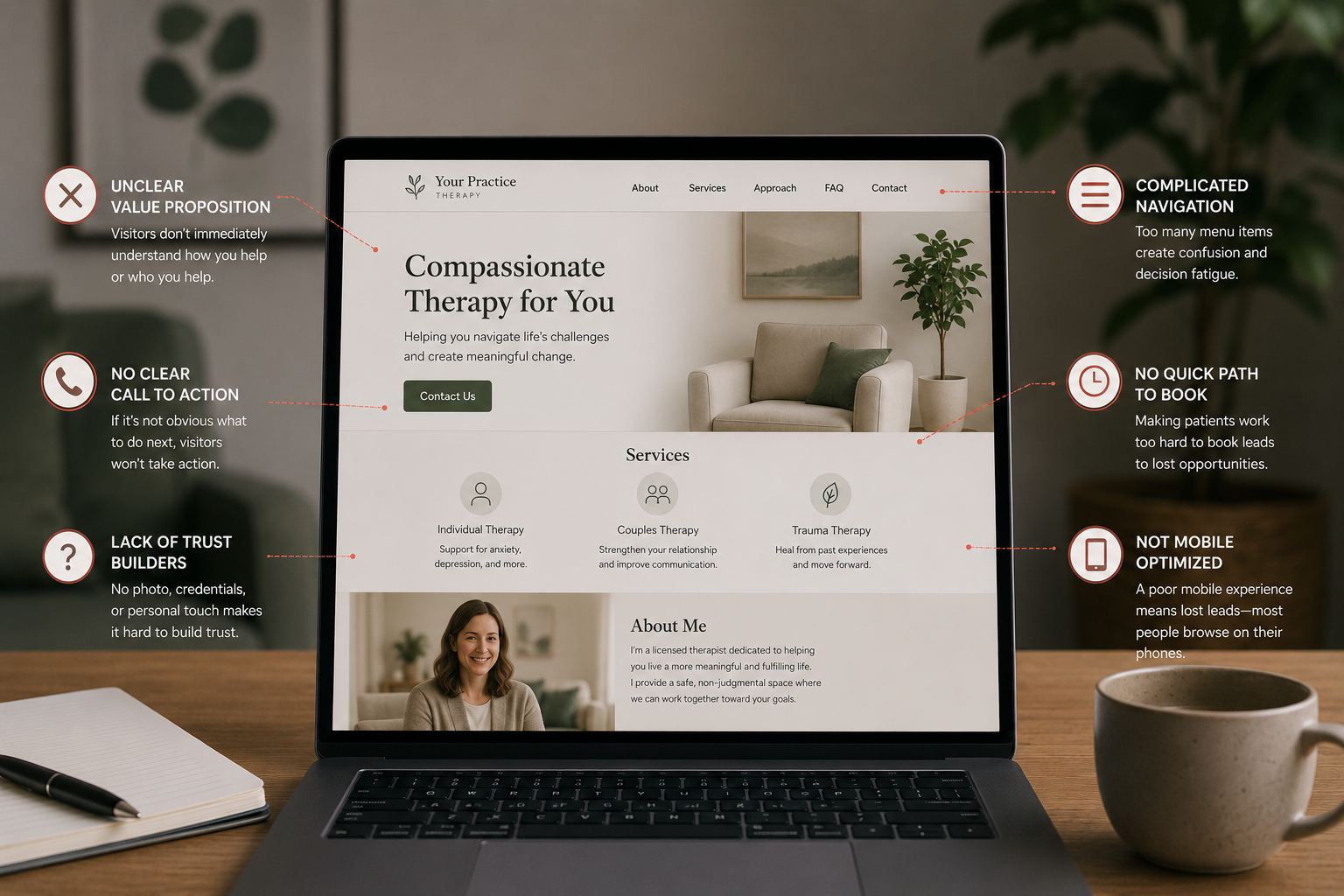
A website built to convert is the only patient acquisition asset that is entirely under your control. You decide what it says. You decide how it looks. You decide how the booking flow works. And when it is built correctly — with a clear headline, a single call to action, and a booking flow that takes under sixty seconds — it converts traffic from every other channel into booked appointments.
Every patient who finds you on Google, sees you on Psychology Today, or gets referred by a friend is going to look at your website before they book. If that website does not convert — you lose them regardless of how well every other channel is performing.
3. A Full Directory Presence Beyond Psychology Today
Psychology Today is one directory. There are dozens more that patients use to find therapists — and most practices are either missing from them or listed with incomplete, inconsistent information.
Zocdoc. Healthgrades. TherapyDen. GoodTherapy. Alma. Google Business. Apple Maps. Bing Places. Yelp.
Each one is a place a patient might find you. Each one also contributes to your local SEO — Google cross-references your information across directories and uses consistency as a ranking signal. A complete, consistent presence across all of them costs nothing beyond the time to set up and maintain it.
4. Automated Follow-Up That Captures Leads Before They Go Cold
Here is something most therapists do not think about: the majority of patients who reach out through any channel — Psychology Today, your website, Google — never actually book.
Not because they changed their mind. Because nobody followed up fast enough.
An automated email and SMS sequence that triggers the second an inquiry comes in keeps the conversation going until the patient is ready to book. It does not matter whether the inquiry came in at 9am on a Monday or 11pm on a Friday. The follow-up goes out immediately. And practices with this in place convert two to three times more of their existing leads without generating a single additional inquiry.
5. Reputation and Reviews Across Every Platform
Psychology Today has reviews. So does Google. So does Healthgrades and Zocdoc and Yelp.
A patient comparing you to another therapist is looking at your reviews across all of these platforms — not just one. A practice with a strong review profile across multiple directories builds trust faster and converts more visitors into booked patients than a practice with reviews on a single platform.
Automated review collection — a post-session email sent at the right moment with direct links to your review pages — builds this presence consistently without you having to ask anyone in person.
6. Content That Brings Patients to You Organically
Every blog post on your website targeting a question your future patients are searching is a patient acquisition channel that runs around the clock without a cost per click or a monthly directory fee.
An article titled "How to Find the Right Therapist for Anxiety" can rank on Google for that search and bring in patients who are already in the decision-making process. An article on "What to Expect From Your First Therapy Session" can rank for that search and bring in patients ready to book their first appointment.
Practices that publish consistent content are building a library of acquisition channels that compound over time. Practices relying entirely on Psychology Today have one channel — and it costs them every single month.
Where Does Psychology Today Fit?
Psychology Today is still worth being on. It has real traffic and real patients use it to find therapists.
But it should be one channel in a system — not the system itself. When your Google presence is strong, your website converts, your directories are complete, your follow-up is automated, and your reviews are coming in consistently — Psychology Today becomes an amplifier rather than a lifeline.
The goal is a practice where no single platform going down, raising its prices, or changing its algorithm can meaningfully impact your patient flow. That is what a real acquisition system delivers.
The Bottom Line
Psychology Today is a starting point. The practices growing consistently beyond it are not finding a better directory — they are building a system that does not depend on any single one.
Multiple channels. Automated follow-up. A website that converts. Reviews across every platform. Content that compounds. All of it running together without requiring your time or attention.
That is what Practado builds and manages for mental health and telehealth practices every single month. Book a free strategy call or visit practado.com/book to see what's included.